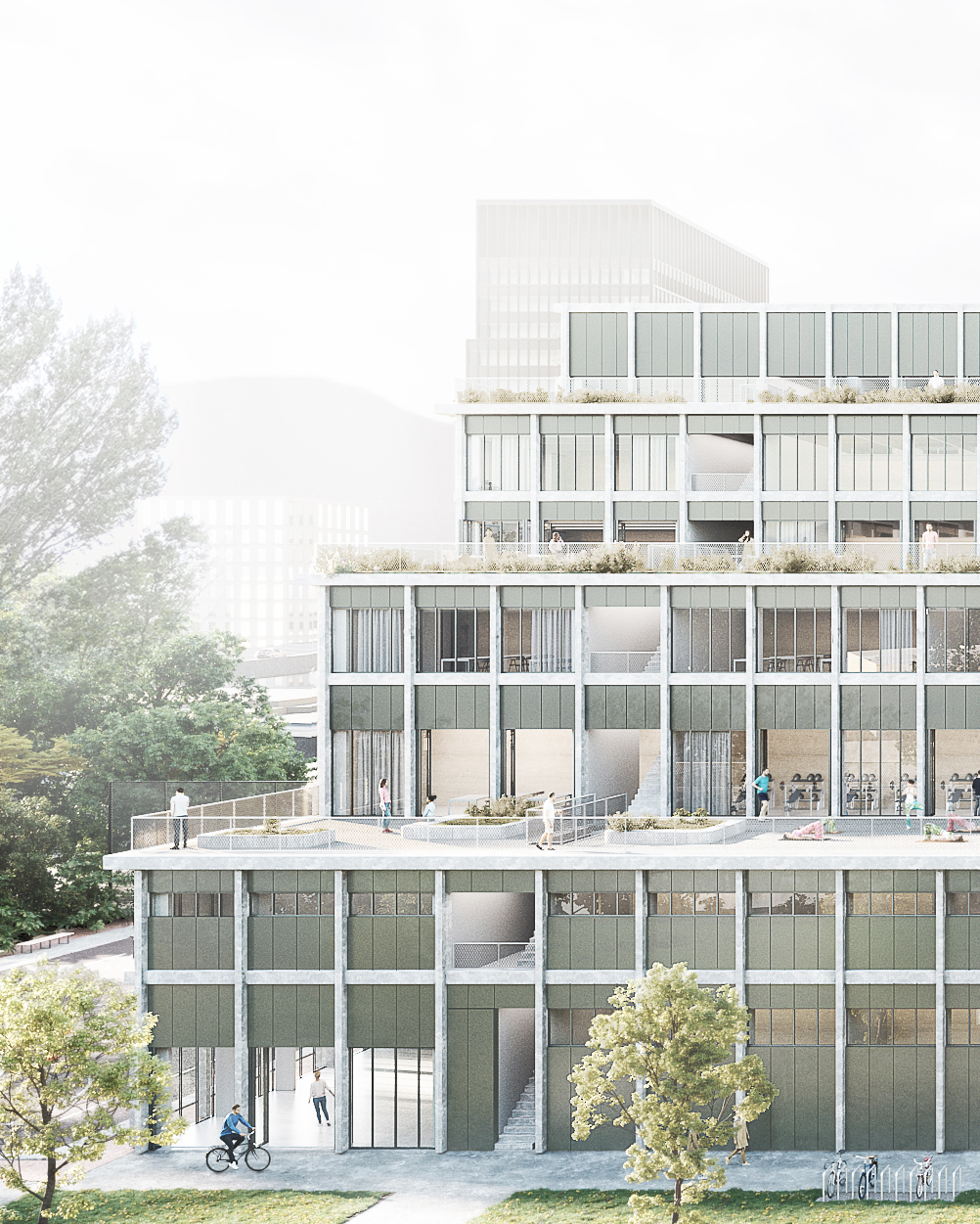
 068_Exterior
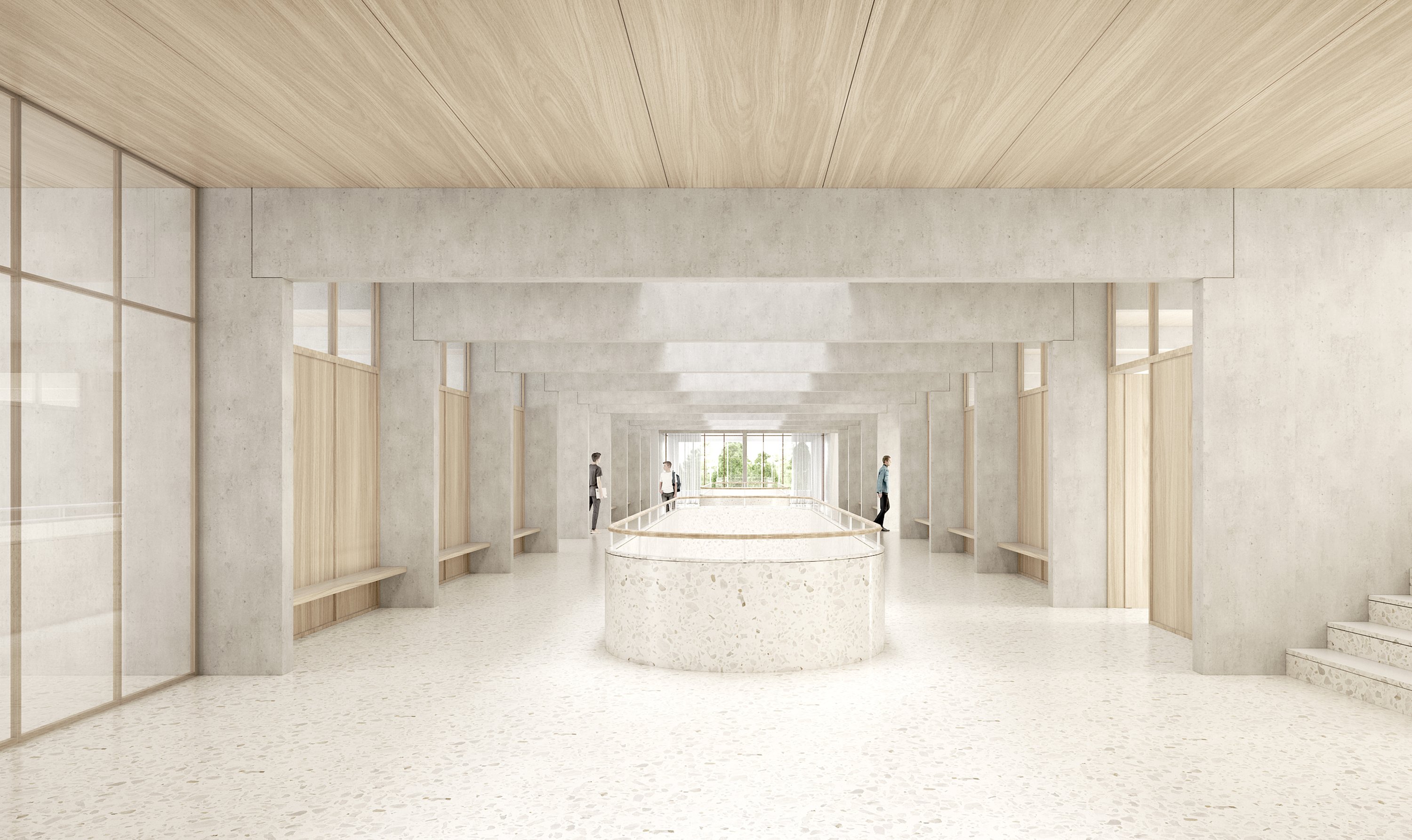 068_Interior
 068_Transversal section


Zurich-Altstetten has changed dramatically in recent decades. The district’s transformation from a village-like fabric into a landscape of office towers and large commercial buildings has reshaped the cityscape. Arriving from the west, by train or by road, this shift is immediately apparent, marking a new urban threshold.
Against this backdrop, the new school complex was placed on a challenging south-eastern site. Bordered by Bernerstrasse with its motorway exit and the Europabrücke with its ramp, the plot sits like an island within traffic. Beyond noise and air pollution, the site also presents technical and spatial challenges: a main sewer line crossing the plot, flood risk, restrictions on basement depth, limited vehicular access, and strict building lines that put pressure on outdoor space. From the outset, the project must overcome these conditions and still create the highest possible quality for its pupils.
Our design responds with a compact, integrated structure that minimizes its footprint and avoids basements altogether. Broad, sheltered terraces define the building and provide outdoor spaces protected from noise. The western forecourt leads to the main entrance, while a separate access point connects directly to the sports facilities in the north. To the east, an all-weather pitch extends the sports program, and to the south, a discreet driveway leads to the ground-floor garage.
The school stands as an autonomous urban figure, continuing the sequence of multi-storey office and commercial buildings along Bernerstrasse while establishing its own identity.
Three vertical cuts organize the volume and form the circulation system. Open, single-flight staircases follow the terraces, allowing students to reach their classrooms directly and intuitively. An internal southern stairwell complements them, ensuring clear and efficient connections between all floors. These three caesuras give structure, orientation, and safe escape routes.
The terraces extend the classrooms outward, offering a wide range of spatial and educational possibilities. Elevated above the traffic, they form a distinctive outdoor world with open views towards the Höngger vineyards.
The building’s supporting structure is conceived as a wood–concrete hybrid. A regular concrete skeleton, designed with slim, repeatable frames, forms the basis. Prefabricated semi-finished elements can be produced off-site and assembled efficiently, shortening construction time and optimizing the building process.
–
STATUS: competition entry
LOCATION: Zürich (CH)
ARCHITECTURE : un-icon + Claire Ensange
LANDSCAPE ARCHITECT : SIMA BREER GMBH
STRUCTURAL ENGINEER : STRUKTURATELIER WOZNIAK+
3D VISUALIZATION : STUDIO NASCENTE